
If you're searching for elder care for a parent in midtown Toronto, you've likely discovered there isn't one single door to walk through. There's a public system, a network of community agencies, and private companies, and each works differently. Understanding who does what will save you weeks of phone calls and help you get the right kind of help sooner.
This guide walks through the main sources of elder care available to midtown Toronto families, what each one covers, and how families typically combine them.
The Public System: Ontario Health atHome
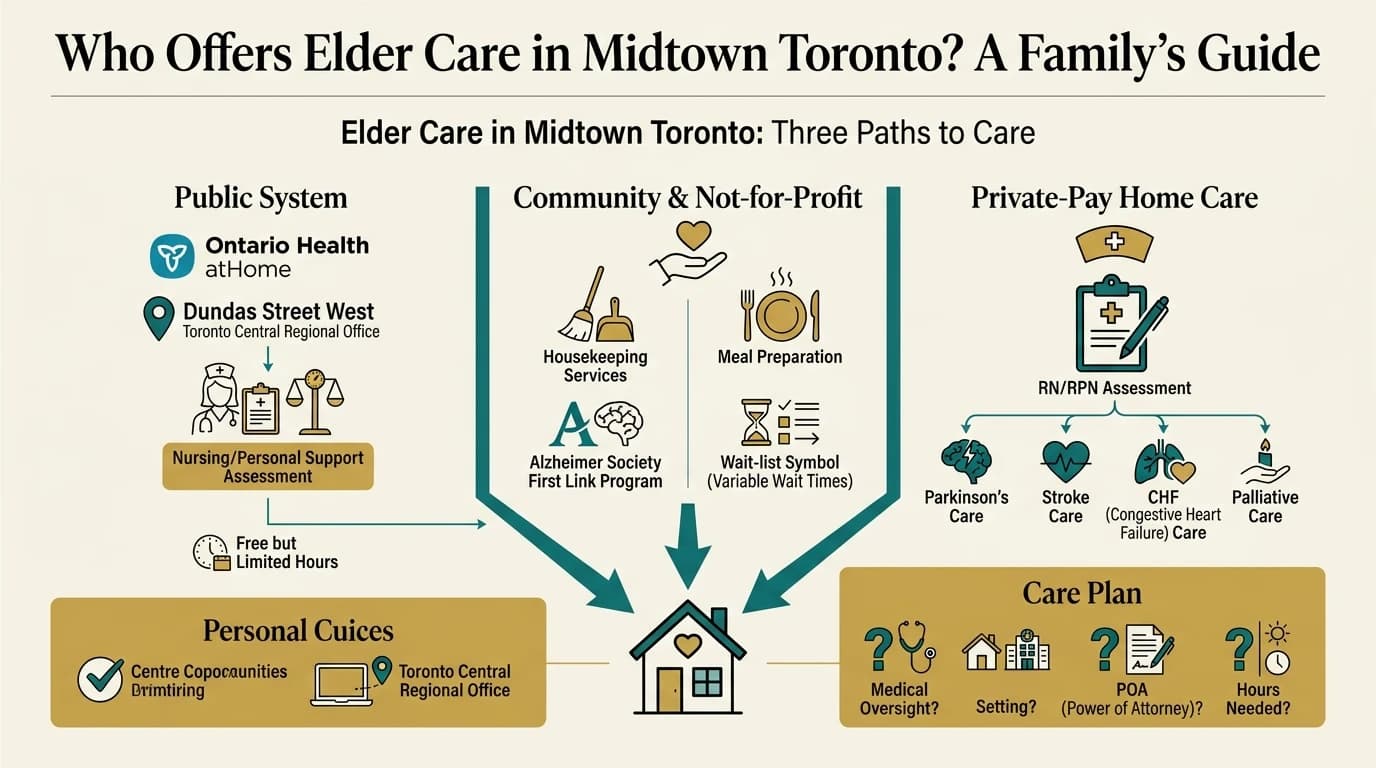
The starting point for most Toronto families is Ontario Health atHome, the provincial organization that coordinates publicly funded home and community care, as well as long-term care placement, across the province. It's the new name for what used to be Home and Community Care Support Services, and before that, the LHINs and CCACs many families remember from years past (Ontario Health atHome) (City of Toronto).
The Toronto Central regional office, which serves midtown, is located on Dundas Street West (Ontario Health atHome). Through this office, an eligible senior can be assessed for publicly funded nursing, personal support, or help with daily tasks like bathing and dressing, and caregivers can access respite support (City of Toronto). Ontario Health atHome can also refer families to other health and social service providers in the community (Government of Ontario).
In practice, families often call Ontario Health atHome first because it's free to apply. The trade-off is that publicly funded hours are allocated based on need and availability, which means the amount of care approved may be less than what a family actually wants, especially for daily support or overnight supervision.
Community and Not-for-Profit Support Services
Alongside the public system, midtown Toronto has a layer of not-for-profit and community agencies that fill in specific gaps. The City of Toronto's Homemakers and Nurses Services Program, for example, helps eligible low-income seniors with light housekeeping, laundry, grocery shopping, and meal preparation, though there is typically a wait list (City of Toronto).
Organizations such as SPRINT Senior Care, an accredited not-for-profit that has supported Toronto seniors since 1983, offer community support services designed to help older adults remain independent (SPRINT Senior Care). If dementia is part of the picture, a family doctor can refer a senior to the local Alzheimer Society through programs such as First Link, which connects families to education, counselling, and support groups (City of Toronto). If you're seeing early signs of memory loss in a parent, a doctor's assessment is the right first step; our overview of dementia care at home explains what typically follows a diagnosis.
Private-Pay Home Care Companies
When public and community programs can't provide enough hours, or when a family wants care on their own schedule, private-pay home care becomes the practical option. The Government of Ontario itself notes that residents can pay for their own care through private companies as an alternative or supplement to publicly funded services (Government of Ontario).
Private care can mean anything from a few hours of companionship a week to 24-hour live-in support, and it can be arranged at home, in a retirement home, in long-term care, or during a hospital stay and discharge. Because private-pay providers set their own hourly rates and minimums, the most reliable way to compare costs is to ask each company directly for a written rate sheet and minimum shift length.
Eldercare Home Health is one of the private companies serving midtown Toronto, offering Personal Support Workers alongside condition-specific services such as Parkinson's Care, Stroke Care, Congestive Heart Failure (CHF) Care, and Palliative Care. Our full list of home care services covers what's available and where it can be delivered.
What Sets a Care Management Model Apart
Many private-pay companies match a caregiver to a client and leave it there. Eldercare Home Health takes a different approach, built around what we call the Care Management Difference. Every plan of care starts with an assessment by a Registered Nurse or Registered Practical Nurse, not a sales representative or intake coordinator. That clinical eye matters: a nurse will typically catch early warning signs, such as skin breakdown risk or medication interactions, that a general caregiver match wouldn't be trained to flag.
From there, a nurse case manager continues to oversee the care plan, adjusting it as a client's needs change, whether that's a Parkinson's client whose mobility is declining or a client recovering from a stroke who needs wound care alongside personal support. You can read more about how this works on our page about the RN case manager difference, and see how it compares to non-medical staffing agencies in our article on non-medical senior care providers versus Eldercare Home Health.
Choosing the Right Fit for Your Family
Most midtown Toronto families end up combining sources rather than picking just one: a referral from Ontario Health atHome, a community program for practical help, and private care to fill the remaining hours. A few questions help narrow the search:
- Does the senior need medical oversight (wound care, medication management, a chronic condition like CHF) or mainly companionship and daily support?
- Is the care needed at home, in a retirement home, or in hospital before a discharge?
- Does a family member hold Power of Attorney, and are they authorized to arrange and pay for care on the senior's behalf?
- How many hours of care are realistically needed each week, and is that number likely to grow?
If you're just starting this process, our guide on arranging home care for a parent living alone in Toronto and our explainer on what elder care actually includes are both good next reads.
Whatever mix you land on, starting with a clinical assessment gives you the clearest picture of what your parent actually needs, not just what a service package includes. You can book a free assessment by a Registered Nurse or Registered Practical Nurse to get that starting point.
Frequently Asked Questions
Is elder care in midtown Toronto free or private-pay?
Both exist side by side. Ontario Health atHome coordinates publicly funded home care and can assess a senior for free, while private companies like Eldercare Home Health charge directly for their services. Many families use a combination of the two.
How do I start the process with Ontario Health atHome?
Contact the Toronto Central regional office, located on Dundas Street West, to request an assessment (Ontario Health atHome). A care coordinator will review the senior's needs and determine what publicly funded services they may qualify for.
What is the difference between community support services and home care companies?
Community agencies, such as those offering the City of Toronto's Homemakers and Nurses Services Program, typically provide practical help like housekeeping and meal preparation and often have eligibility rules and wait lists. Private home care companies provide flexible, paid support, including personal care and skilled nursing oversight, on a schedule the family sets.
Why does a nurse-led assessment matter for elder care?
A Registered Nurse or Registered Practical Nurse can identify medical risks, such as fall hazards, medication concerns, or early signs of a condition like Parkinson's or dementia, that a non-clinical intake call would miss. This leads to a more accurate, safer care plan from the start.
Who should arrange elder care if a parent can't manage it themselves?
If a Power of Attorney for personal care has been named, that person is typically responsible for arranging care and making health-related decisions. If no POA exists, it's worth speaking with a lawyer or your family doctor about next steps, particularly if your parent is not able to make these decisions independently.