
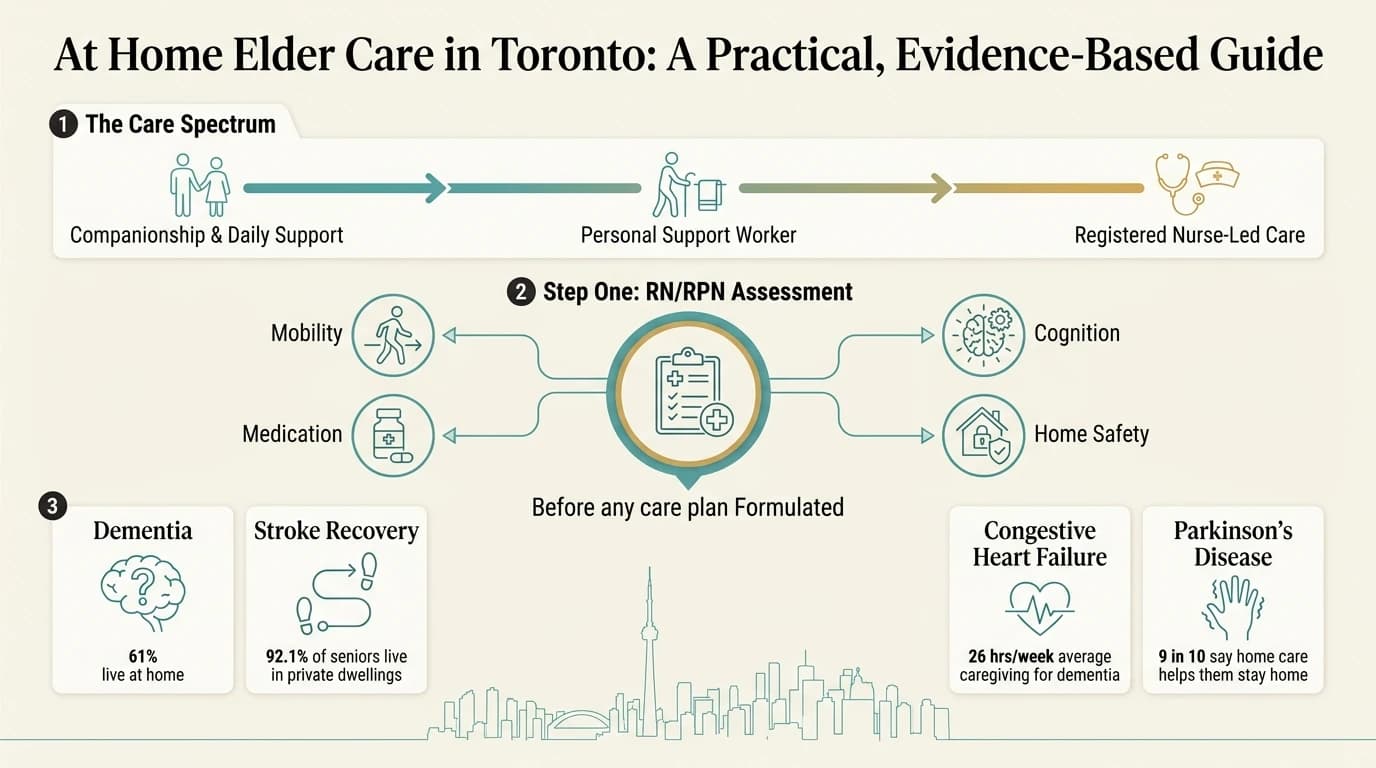
Most families do not set out to become experts in eldercaring. They arrive at it gradually, after a fall, a hospital stay, or a quiet realization that a parent is managing less well than they let on. At home elder care is the term for the support that lets a senior stay in their own home, or in a retirement home or long-term care setting, while getting the help they actually need. This guide looks at what that care involves, what the research says about it, and how to start building a plan that fits your family.
What "At Home Elder Care" Actually Covers
At home elder care is not one service. It is a spectrum that can include help with bathing and dressing, medication reminders, meal preparation, mobility support, and skilled nursing care for a specific condition. In Toronto, families draw on a mix of publicly funded home care through Ontario Health at Home and private-pay services to fill the gaps. The right mix depends on the person: a client recovering from a stroke needs something different from a client living with advanced dementia or congestive heart failure.
In practice, families often start with a few hours a week of support and adjust from there as needs change. A Personal Support Worker might help with morning routines a few days a week, while a Registered Nurse oversees the overall care plan and steps in for wound care, medication management, or condition-specific monitoring.
Why Staying Home Matters, and What the Evidence Shows
The preference to age at home is not just sentimental. 92.1% of Canadian seniors aged 65 and older live in private dwellings in the community, and the evidence suggests that, for many, staying there with the right support leads to better outcomes than moving prematurely into institutional care. Among Canadian seniors who received publicly funded home care, 9 out of 10 said it helped them remain at home, and 93% reported being satisfied with the service.
This matters at a system level too. Research suggests that 11% to 20% of new long-term care admissions in Canada involved people with low to moderate care needs, people who might have been able to stay in their own homes with adequate home care support in place. As Canada's population ages (Statistics Canada projects the number of seniors will grow by about 4 million over the next 20 years, with the population 75 and older doubling by 2037 according to the Canadian Institute for Health Information), the gap between demand and available home care support is likely to widen. Planning early, rather than waiting for a crisis, gives families more options.
The Nurse-Led Assessment: Why It Comes First
A good care plan starts with an accurate picture of what a person actually needs, not a guess. That is the reasoning behind the RN case manager difference: every plan begins with an assessment by a Registered Nurse or Registered Practical Nurse, not a sales call. The nurse evaluates mobility, cognition, medication management, home safety, and the specific demands of any diagnosed condition, then recommends a plan and adjusts it as circumstances change.
This matters because needs shift. A client discharged from hospital after a cardiac event needs different support in week one than in month three. Families can book a free assessment by a Registered Nurse or Registered Practical Nurse to get that clarity before committing to a schedule or a budget.
Condition-Specific Care at Home
Generic help is useful, but many seniors need care built around a specific diagnosis. Some examples:
- Dementia: About 61% of seniors with dementia in Canada live at home, and dementia prevalence rises sharply with age, from under 1% at 65 to 69 to roughly 25% at 85 and older, according to CIHI. Dementia care at home usually focuses on routine, safety, and communication strategies that reduce agitation.
- Stroke recovery: Stroke care at home often combines mobility support with therapy referrals and close monitoring for secondary complications.
- Congestive heart failure: CHF care at home centres on symptom tracking (weight, swelling, breathlessness) so problems are caught before they require an emergency room visit.
- Parkinson's disease: Parkinson's care plans typically account for medication timing, which can be more time-sensitive than families expect, and for the physical demands of changing mobility.
Always involve the person's doctor or pharmacist when a care plan touches on medication changes or new symptoms; a home care plan supports medical care, it does not replace it.
The Toll on Family Caregivers
Families providing informal care for a parent with dementia give, on average, 26 hours of caregiving per week, compared with 17 hours per week for those caring for a senior with other health issues. That is close to a part-time job layered on top of everything else in a family member's life. Bringing in professional support, even a modest number of hours a week, is often less about replacing family care and more about making it sustainable.
Recognizing When It's Time to Start
Signs that a parent needs more support at home are often subtle at first: unopened mail, missed medications, a fridge with expired food, or a fall that gets brushed off. If any of this sounds familiar, our guide on warning signs a senior needs help at home walks through what to watch for and how to raise it with a parent gently.
Getting Started
The most useful first step is usually not a decision, but a conversation. A free assessment by a Registered Nurse or Registered Practical Nurse gives you an objective picture of what your parent needs now, and a realistic sense of how that might change. From there, you can review the full range of home care services we provide and build a plan that fits your family's situation and budget.
Frequently Asked Questions
What is the difference between elder care and home care?
Elder care is the broader term for any support that helps a senior manage daily life, whether that is at home, in a retirement home, or in long-term care. Home care specifically refers to services delivered in a private residence.
How much does at-home elder care cost in Toronto?
Costs vary widely depending on the number of hours, the type of care (personal support versus skilled nursing), and whether services are private-pay or publicly funded. The most reliable way to get a realistic figure is to ask for a written quote after a nurse-led assessment, which accounts for your parent's specific needs.
Can home care work alongside publicly funded services through Ontario Health at Home?
Yes. Many families combine publicly funded home care hours with private-pay services to cover gaps in scheduling or to add specialized support, such as wound care or overnight supervision.
What happens after a hospital discharge if my parent needs ongoing care?
A structured transition plan, ideally arranged before discharge, reduces the risk of readmission. Our hospital discharge support page outlines how a nursing assessment can be arranged quickly to bridge that gap.
Who has power of attorney for care decisions if my parent can't advocate for themselves?
This depends on the Power of Attorney for Personal Care document your parent has in place, or on Ontario's substitute decision-making rules if no document exists. A lawyer or your care coordinator can clarify who is authorized to make decisions on your parent's behalf.