
You visit your mother every few weeks and everything seems fine. Then one Sunday you notice the mail piled up on the hall table, a bruise on her forearm she brushes off, or the same cardigan she wore last visit. None of these things alone is alarming. Together, they are often the first real signal that a parent needs more support than they're getting.
Adult children are usually the ones who notice first, because they see their parent intermittently rather than every day. Small changes that would be invisible up close become obvious when you only see someone once a month. Here is what our care team watches for when families ask, "Is it time?"
Falls, Bruises, and Changes in Mobility
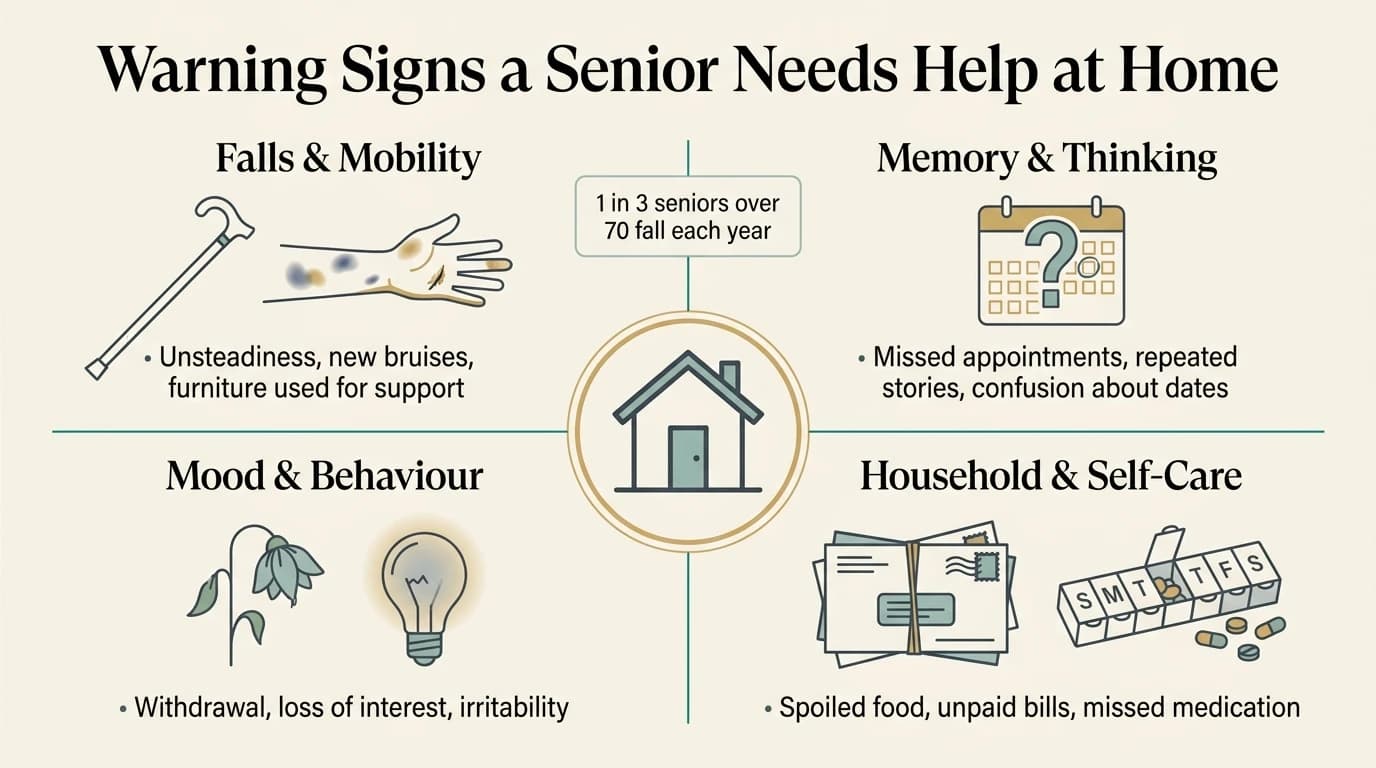
Falls are one of the clearest and most dangerous signs that a senior needs help at home. About a third of adults over 70 fall each year, and the rate climbs with age (Canada.ca). Falls are also the leading cause of injury-related hospital stays for people 65 and older: data from the Canadian Institute for Health Information show that 81% of Canadians 65+ admitted to hospital for an injury in 2017-2018 were hurt in a fall (CBC News), and 71% of all fall-related hospital stays happen in this age group (CIHI).
Nearly half of these falls happen in or around the person's own home (PHAC), which makes the home itself worth a careful look. Watch for:
- Unexplained bruises, or a story about a fall that doesn't quite add up
- New unsteadiness getting up from a chair or navigating stairs
- Furniture being used for support that wasn't there before (a hand always on the wall)
- Throw rugs, poor lighting, or clutter in walkways that used to be tidy
In practice, a Registered Nurse doing a home assessment will often spot fall risks the family has walked past for months: a loose stair runner, a missing grab bar, medication that causes dizziness. If your parent has had a fall, our guide on hospital discharge support covers what safe planning looks like when they're heading home.
Changes in Memory and Thinking
Early dementia rarely announces itself. It shows up as a missed bill, a repeated question, or a recipe your mother has made for forty years that suddenly goes wrong. The Alzheimer's and dementia care community notes that early changes in thinking, remembering, and reasoning affect daily life well before a diagnosis is made, and that people will gradually need more help with simple, everyday tasks (Alzheimers.gov).
Signs worth taking seriously:
- Forgetting appointments, or the same story told multiple times in one visit
- Confusion about the day, date, or season
- Trouble following a familiar recipe or process
- Getting lost on a route they've driven for decades
If you're noticing these changes, our Dementia Care team, and our page on what dementia care at home looks like, can help you understand what support might help now, before a crisis forces the decision.
Changes in Mood, Behaviour, and Social Life
Mood changes are among the easiest signs to miss, and among the most telling. Depression in older adults is often mistaken for normal aging, and it can be easy to hide during a short visit (NIA). Look for:
- Withdrawing from friends, clubs, or family calls they used to enjoy
- Losing interest in hobbies or appearance
- Irritability or flatness that feels out of character
- Sleeping far more or far less than usual
A short visit won't always reveal this. Staying for a full meal, or dropping by unannounced, often tells you more than a scheduled Sunday call.
Household and Self-Care Clues
The home itself often tells the story before your parent does. Common signals our nurses and Personal Support Workers are trained to notice on a first visit include:
- Spoiled or expired food in the fridge
- Unopened mail, unpaid bills, or notices piling up
- Laundry undone, or the same clothing worn repeatedly
- Missed medication doses, or pillboxes that don't match the calendar
- A house that smells different than it used to (a sign personal hygiene or housekeeping has slipped)
One clue rarely means much. Several together, especially a new pattern, usually does. If your parent lives alone and you're weighing what to do next, our article on arranging home care for a parent living alone in Toronto walks through the practical next steps.
What to Do With What You're Noticing
You don't need to have all the answers before you act. What helps most is an objective, clinical look at the whole picture: mobility, medication, memory, mood, and the home environment together. That's the purpose of a nurse-led assessment.
Eldercare Home Health's care management model means every client's care starts with an assessment by a Registered Nurse or Registered Practical Nurse, not a sales call. The nurse looks at falls risk, cognitive changes, chronic conditions like CHF, Parkinson's, or stroke recovery, and day-to-day safety, then recommends a plan built around your parent's actual needs. You can read more about how this works on the RN case manager difference page.
If you recognize even two or three of the signs above, it's worth having that conversation now rather than after an ER visit. Book a Free Assessment by a Registered Nurse or Registered Practical Nurse and get a clear, professional picture of what your parent needs.
Frequently Asked Questions
How many warning signs mean it's time to arrange care?
There's no fixed number. One isolated incident, like a single missed appointment, usually isn't cause for alarm. A cluster of changes across mobility, memory, mood, and the home environment, especially if they're new, is the strongest signal that it's time to bring in help.
My parent insists they're fine. What should I do?
This is common, and understandable: admitting you need help can feel like losing independence. Framing a nurse's visit as a general check-in or safety review, rather than a decision already made, often lowers resistance. A free, no-obligation assessment lets your parent hear directly from a clinician what's actually needed.
Are falls really that serious for seniors?
Yes. Falls are the leading cause of injury hospitalization for Canadians 65 and older, and seniors are especially likely to be hospitalized for a hip fracture after a fall (CIHI). Even a fall that seems minor is worth mentioning to a doctor or care coordinator.
Can home care help if my parent has dementia and keeps falling?
Yes. Seniors living with dementia are hospitalized for falls at more than double the rate of those without dementia (CIHI), which makes home safety and supervision especially important. Our Dementia Care team can build a plan that addresses both cognitive support and fall prevention together.
What happens during a nurse-led assessment?
A Registered Nurse or Registered Practical Nurse visits your parent's home, reviews their medical history, medications, mobility, and living environment, and talks with your parent and family about daily routines and concerns. From there, they recommend a care plan tailored to your parent's needs, whether that's Personal Support Workers, wound care, or condition-specific support.