
Ontario Health Care System
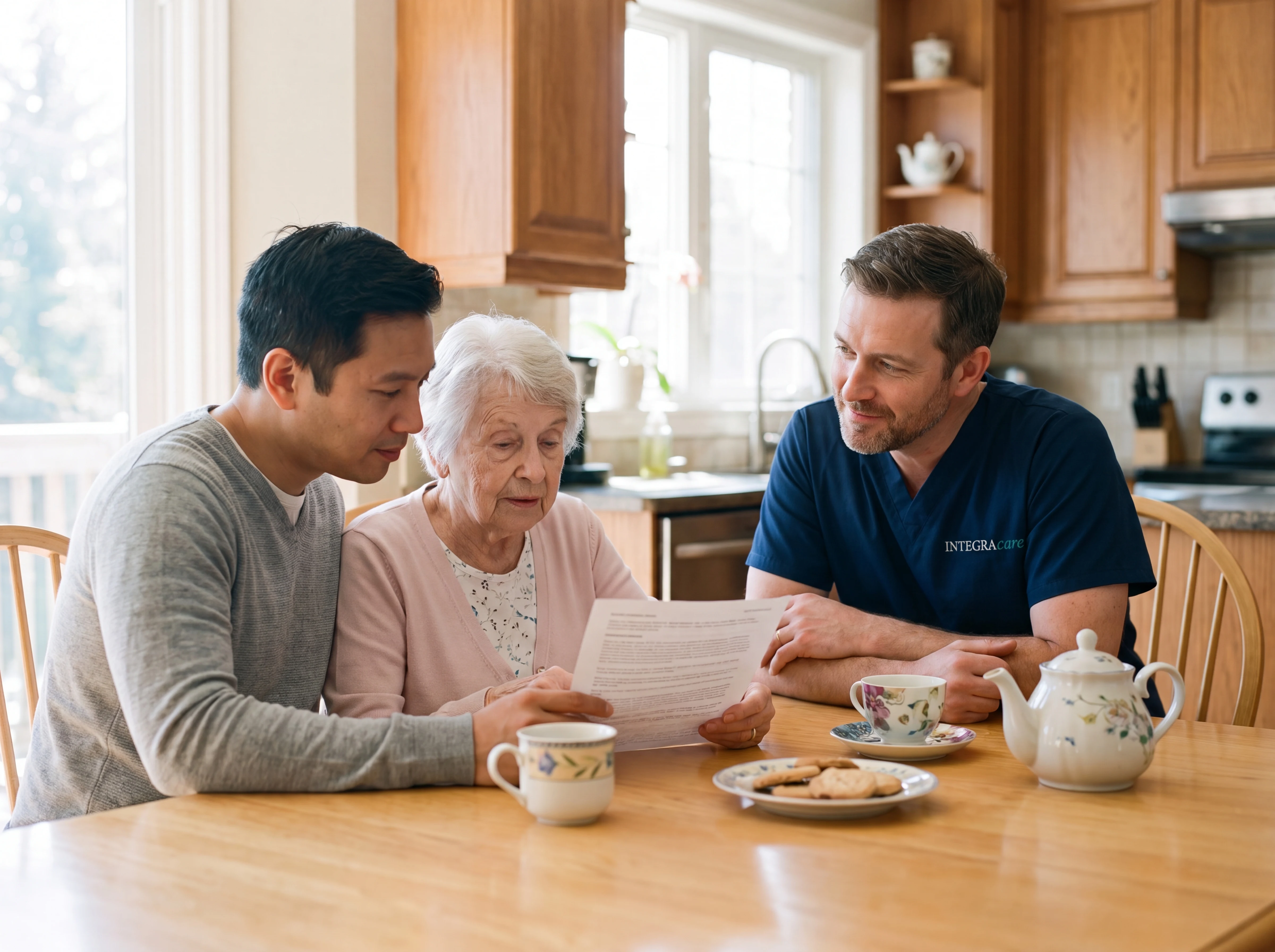
How the Ontario health care system and Ontario Health atHome can help you.
We’ve taken a fairly common situation – a Senior returning home from the hospital, as an example. You’ll learn about the hospital discharge process and get an overview of the how things work. Read on…
Please keep in mind that while it’s useful to have an overview of how the Ontario health care system works, your circumstances are unique to you. There is no one size fits all Senior home care solution.
For the sake of simplicity we’ve used the term “Client” to describe the Senior who is returning home. The term “Client” has replaced “patient” at many hospitals.
Also, we have numbered and named the steps in the discharge process. In reality no-one actually refers to the steps as separate steps, they are all one process.
Step 1 – Notification of Discharge:
Usually the hospital will notify the family that they plan on discharging the client. Notice can be as short as one day or as long as a week in advance of the discharge date.
Step 2 – Needs Assessment:
The hospital Discharge Planner (or, in some cases Social Worker) will help the family identify the arrangements that need to be made in order for the discharge to be successful. The Discharge Planner is not responsible for actually making the arrangements, although they will, on occasion, assist in making some of them.
Step 3 – Coordination:
Generally the family is responsible for coordinating all the various services that may need to be put in place, booking follow up doctors appointments and arranging all the household details – making sure food is in the refrigerator, medications are up to date, old prescriptions have been removed from the household, the household environment is safe (with the limitations that the client now has), etc. With the support of Eldercare Home Health, our Care Managers can assist in this coordination effort.
Step 4 – Ontario Health atHome evaluation:
Hospitals have an Ontario Health atHome (formerly HCCSS) coordinator on-site who determines the number of “home care” hours of care the client is eligible for under the government program. Note: HCCSS was previously known as LHINs and prior to that was known as CCAC.
Step 5 – Transfer home:
The family may make arrangements to transfer the client home themselves or, if required they can book a transfer ambulance through the hospital.
In an ideal world, all services would be in place and all details have been sorted out prior to the Client’s arrival home. In reality, this seldom happens. It is not unusual, for example for Clients to return home without their medication, without a new prescription, without an exercise schedule, wheelchair etc.
With the support of Eldercare Home Health, our Care Managers can assist in arranging transfer transportation and accompaniment, and ensure that the Client is ready to safely return home.
Step 6 – Homecare:
For most people it is comforting to have a consistent caregiver.
Unfortunately, due to a variety of factors, it is very difficult for agencies contracted by Ontario Health atHome to provide consistent caregivers for clients.
(A note here regarding Ontario Health atHome caregivers. Ontario Health atHome contracts independent companies to provide caregivers on its behalf. Ontario Health atHome itself does not employ caregivers).
Eldercare Home Health is not an Ontario Health atHome care provider, although we are fortunate to have a very good relationship with many of the Ontario Health atHome offices. At Eldercare Home Health, we are accountable directly to you and there is always someone to talk to if you have any questions regarding any aspect of the care we provide.
Step 7 – Ongoing supervision of care and health:
There are many considerations for a successful return home. Having the right care in place is key, but there are other factors that can also make a significant difference to the health of Clients: maintaining a clean environment, nutritional considerations, mental stimulus, socialization, exercise regimen, monitoring changes in health status, communication between health professionals and family members, coordination of services etc.
Step 8. Awareness of change in condition:
It is important that the Client’s condition is monitored and that a knowledgeable care professional take appropriate action when health changes occur.
At Eldercare Home Health providing care for Seniors is all we do
We know how the Ontario healthcare system works, what services our Clients are entitled to receive through Ontario Health atHome and how to access them. We also know the limitations and challenges facing Ontario Health atHome and can help Clients overcome these challenges with supplemental care. We advocate for the well-being of our Clients and coordinate and monitor all delivery of services, from equipment to home blood work, medication administration and personal care. Want to learn more? Contact us now.